January 24, 2024
Dear Readers and Viewers,
Through this blog, I would like to share with you rubber-molded products, methods of manufacturing, and improved technologies, which is one of the polymers playing a vital role in all sorts of engineering, such as mechanical, electrical, electronics, chemical, and civil.
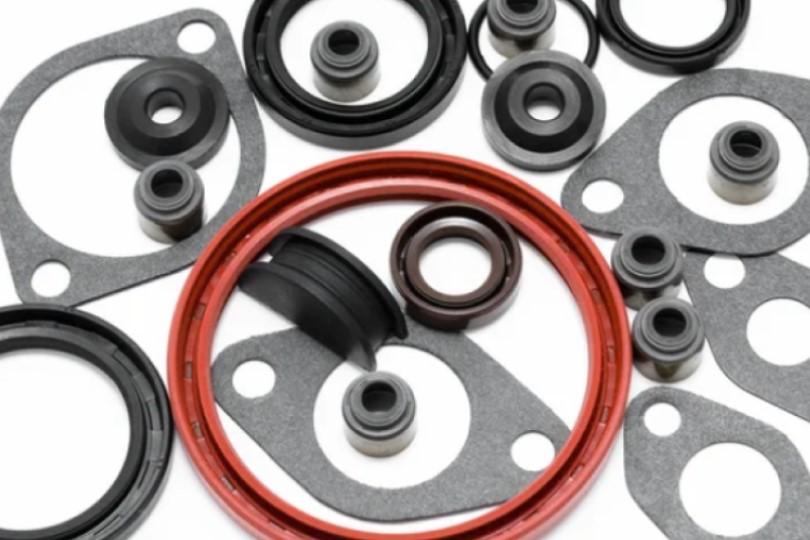
Different types of parts, products, and components made out of rubber are widely used in different types of tools, devices, accessories, equipment, assemblies, machines, plants, systems, etc. related to different sectors such as electrical, electronics, communication, chemical, civil, mechanical, medical, agriculture, transport, etc.
The majority of the time, rubber items or parts are utilized to stop undesirable mechanical movements or reactions like vibrations, leakage, abrasion, and conduction. Similar to how they guard against breaking or cracking, rubber parts are also frequently employed to maintain smoothness, provide insulation, seal, and, lastly, provide an appealing appearance.
Both natural and synthetic rubber are used to make rubber products, depending on the kind and use of the product. Comparably, there are three ways to make rubber parts: extrusion and vulcanizing (e.g., conveyor belts), molding and vulcanizing (e.g., tires, oil seals), and dipping and vulcanizing (e.g., hand gloves).
Depending on the type of product and its application, different methods or technologies, such as mixing, dipping, compression molding, injection molding, transfer molding, extrusion, vulcanizing, etc., have been introduced to manufacture different types of rubber-molded parts or products.
Similarly, depending on the requirement, different types of production facilities are used to carry out different processes, such as studying, designing, fabricating accessories, mixing, performing, molding, de-flashing, finishing, testing, packing, etc., to manufacture quality rubber parts to the customer’s specification.
After the completion of product design, the overall quality of the rubber part mainly depends on three facts: the design of the mold (example: material for the mold, method of fabrication), the composition of the mixture (example: quality and quantity of chemical ingredients, effective dispersion of ingredients with the natural / synthetic rubber), and the method of finishing (example: accuracy and level of surface finish after molding).
The success of purpose in the introduction of any rubber part or product depends on various facts, such as product design with respect to a detailed study of the end application, selection of manufacturing method, design of the tools, mold, and accessories, selection of type of rubber (natural or synthetic), quality of chemical composition, method of finishing, method of testing, etc.
SUMMARY
The quality of a rubber part depends on the perfect product design.
The quality of a rubber part depends on a detailed study of its end application.
The quality of a rubber part depends on the design of the tools, mold, accessories, and method of fabrication.
The quality of a rubber part depends on the quality of the raw material and its chemical composition.
The quality of a rubber part depends on the effective dispersion of chemical ingredients with the natural or synthetic rubber.
The quality of a rubber part depends on the method of molding or vulcanizing it.
The quality of a rubber part depends on the method of finishing after molding.
The quality of a rubber part depends on the testing facilities.
In this connection, I have a lot of worthwhile designs and technologies for manufacturing rubber products to achieve further benefits of up to 50% in total compared to the existing technologies.