January 19, 2024
Dear readers,
Through this blog, I would like to share my success and experience that I have gained at the first attempt at joining two costly parts made of two different metals from a similar family by introducing the cryogenic shrink fitting technique. Before going to the point of the aforesaid subject, in this connection, I wish to recall once again the following to you, which you knew very well:
In general, the stationary portion will be introduced to interference fit with some degree of excess force depending on the type of metal and its application out of two parts fitted to accomplish a rotating movement at a desired rotational speed (example: fitment of bearing and housing).
Similarly, two stationary parts made of two different or similar metals (for example, bushings) will be introduced to interference fit with some degree of excess force, causing the other part to slide or rotate gently.
In another case, two stationary parts with different shapes made of two different or similar metals (example: hydraulic cylinder with square or rectangle flange) will be permanently joined together by introducing an interference fit with the help of a different method of welding and then finished by a suitable machining process.
The aforementioned fitments (permanent joints) can also be successfully finished using the heat shrink method without the use of external force, depending on the application and geometrical circumstances (for example, the bush assembly fitted in the material handling equipment).
The cryogenic shrink fitting technique, with the help of introducing liquid nitrogen, is an advanced technique that can be used to create a permanent joint that allows for all types of movements without the use of external force, eliminates distortion, and necessitates a machining process for finishing.
In order to join two sets of cylinder assembly—two cylinders and four flanges—which is one of the components of the extruder used to produce instant food products, I decided to use the cryogenic shrink fitting technique. Because I followed the data and references in the correct order that I had calculated and derived before beginning the operation, I was able to successfully complete the entire fitment in a single attempt.
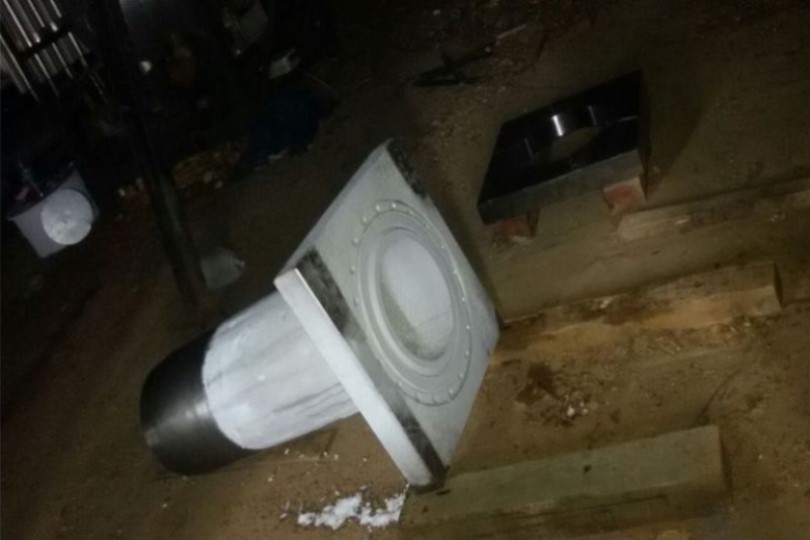
This image shows our success with the cryogenic shrink fitting technique used to join a cylinder (OD-240 mm, ID-200 mm, OL-1500 mm) made of stainless steel of grade SS-316L with a square flange (540mm * 540 mm* 75 mm) made of grade SS-304 stainless steel, demonstrating the enhanced quality of the process of fitting and eliminating the need for welding, post-weld deformation, and finishing by machining.
SUMMARY
If the procedure, along with calculation, proper planning, and training, will be strictly followed, then:
Permanent joints can be achieved to any degree of geometrical accuracy by introducing the cryogenic shrink fitting technique.
Permanent joints can be achieved more effectively by introducing either similar or bi-metal cryogenic shrink-fitting techniques.
Permanent joints can be achieved more effectively without externally applied force, distortion, or deformation using the cryogenic shrink fitting technique.